
CASE STUDY
Prototype by: Lyndsey Fisk
Open Claude, type a question. It answers in seconds.
You got what you needed. But did you get smarter?

I'm Lyndsey Fisk, I've researched AI-assisted interactions for Microsoft, and founded International learning curriculums.
Note: This is intended as a sample of thinking, without known constraints or decisions frameworks the Anthropic team have already established.

SITUATION

AI is in our pocket and we're more capable than ever. But are we smarter? Or have we fallen into the role of becoming a prompt conduit between need and outcome?
Sweden just answered that question the hard way. They're abandoning a decade long digital-first learning strategy, and placing a $100 million bet on reverting schools to physical textbooks, pens and paper. A reaction to its first generation of students in recorded history finishing school less educated than their parents.
However, if the work I've done throughout my career has taught me anything, it's that the culprit of these problems is rarely technology itself. It's the experience design encapsulating it.
This isn't a Sweden problem, it's not a technology problem. This is a design problem. And it's about to get significantly harder to ignore.

MY OBSERVATION

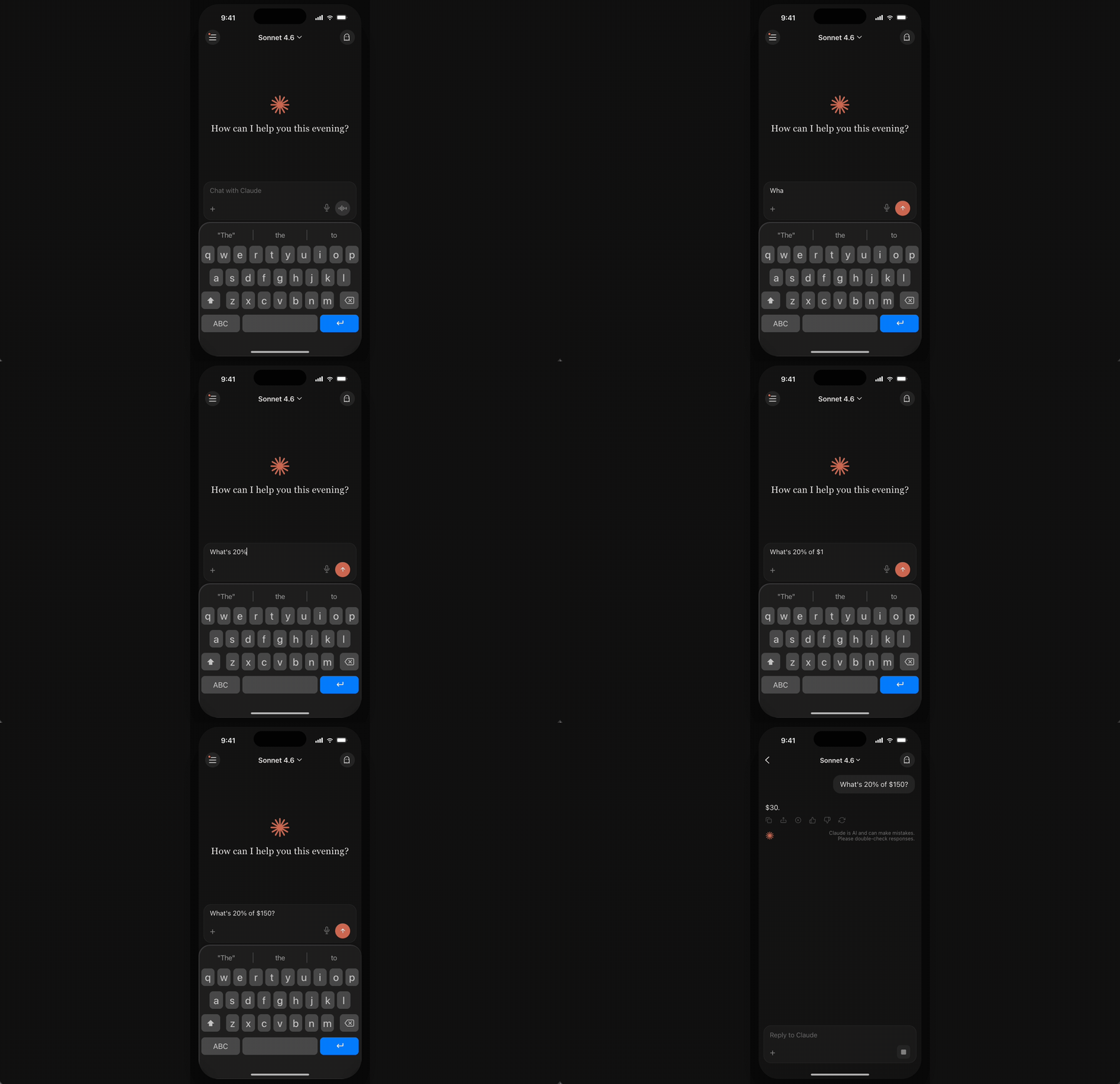
How Claude answers questions today
Something happened to me recently. I asked Claude a question, got a perfect answer, and moved on with my day.
Hours later I was Googling the same problem. Nothing had stuck. I'd outsourced the thinking so efficiently that I hadn't learned anything on the topic. It's the same dynamic as a student asking the teacher for the exam answers, the work gets skipped, and so does the learning.
This is the core tension AI raises in assisted learning environments. We can use Human Computer Interaction principles to look at this in two modalities, one that enables learning, one that disables it. Let's break that down.
Disabling: Learning though implicit interactions
The current model. AI understands intent and answers as a utility to serve your need, not as a learning-first experience. It's fast, frictionless, also forgettable. Think of this as trying to enter a building and the doors automatically open for you.
Pros: Immediacy of outcome
Cons: No active learning engagement. Nothing transfers.
Enabling: Learning though explicit interactions
A different experinece focused on user control. Providing friction that must exist to get to an outcome, or is introduced to create the conditions for learning. Here the door to the building is closed with a pin code, you've got to apply problem solving to figure out how to get through it.
Pros: Active engagement. People learn by doing
Cons: Perceived effort, which reduces willingness to engage
If we apply AI-chat experiences in learning environments, as I've explored with Microsoft, Universities, and Fatiguefit, we need more explicit interaction design, interaction experiences that drive the act of learning itself.
This brings us to our first design challenge for Claude.
How might we create an explicit learning environment within a utility based AI chatbot?

PROTOTYPING A SOLUTION

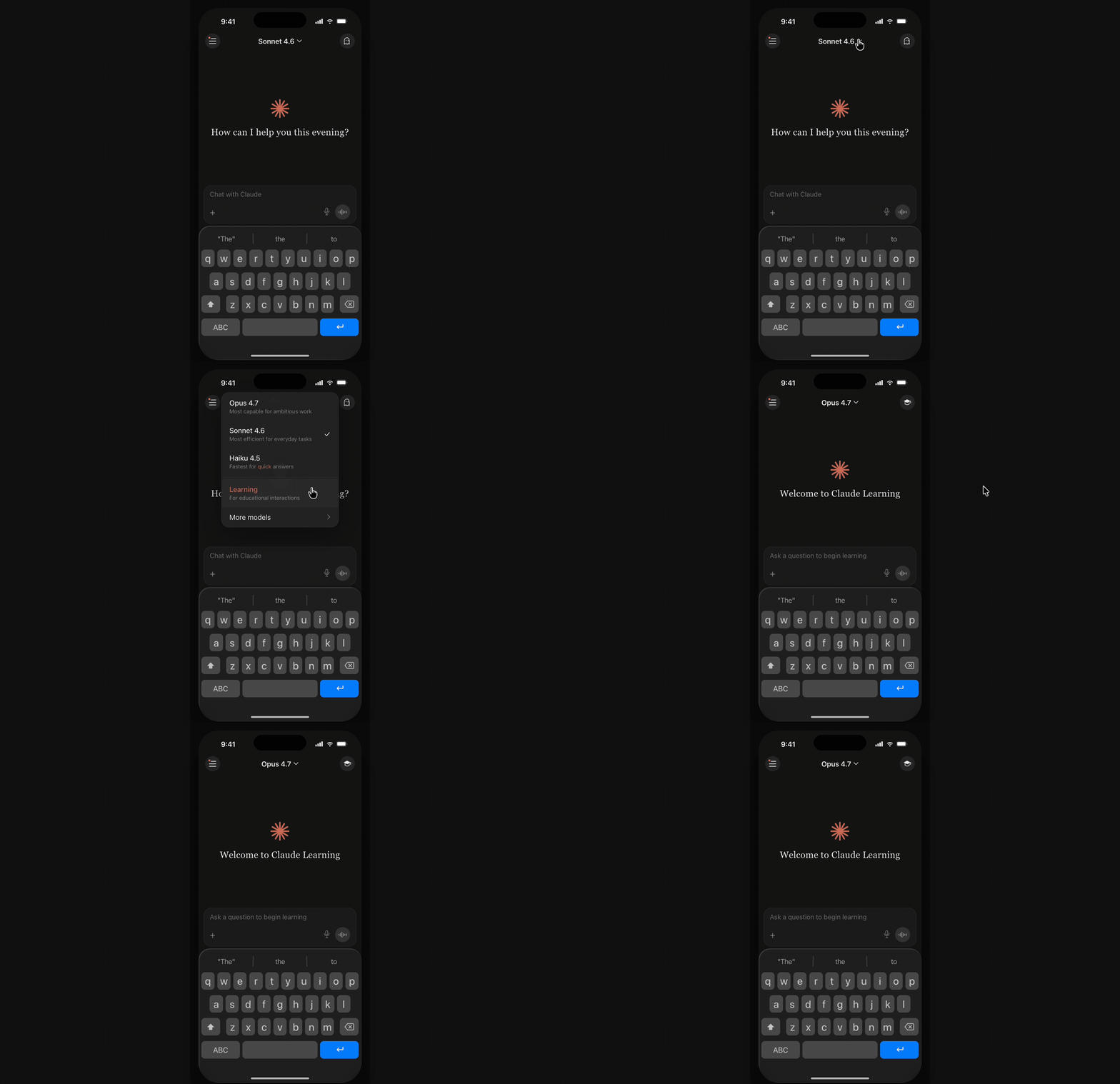
Prototype by: Lyndsey Fisk
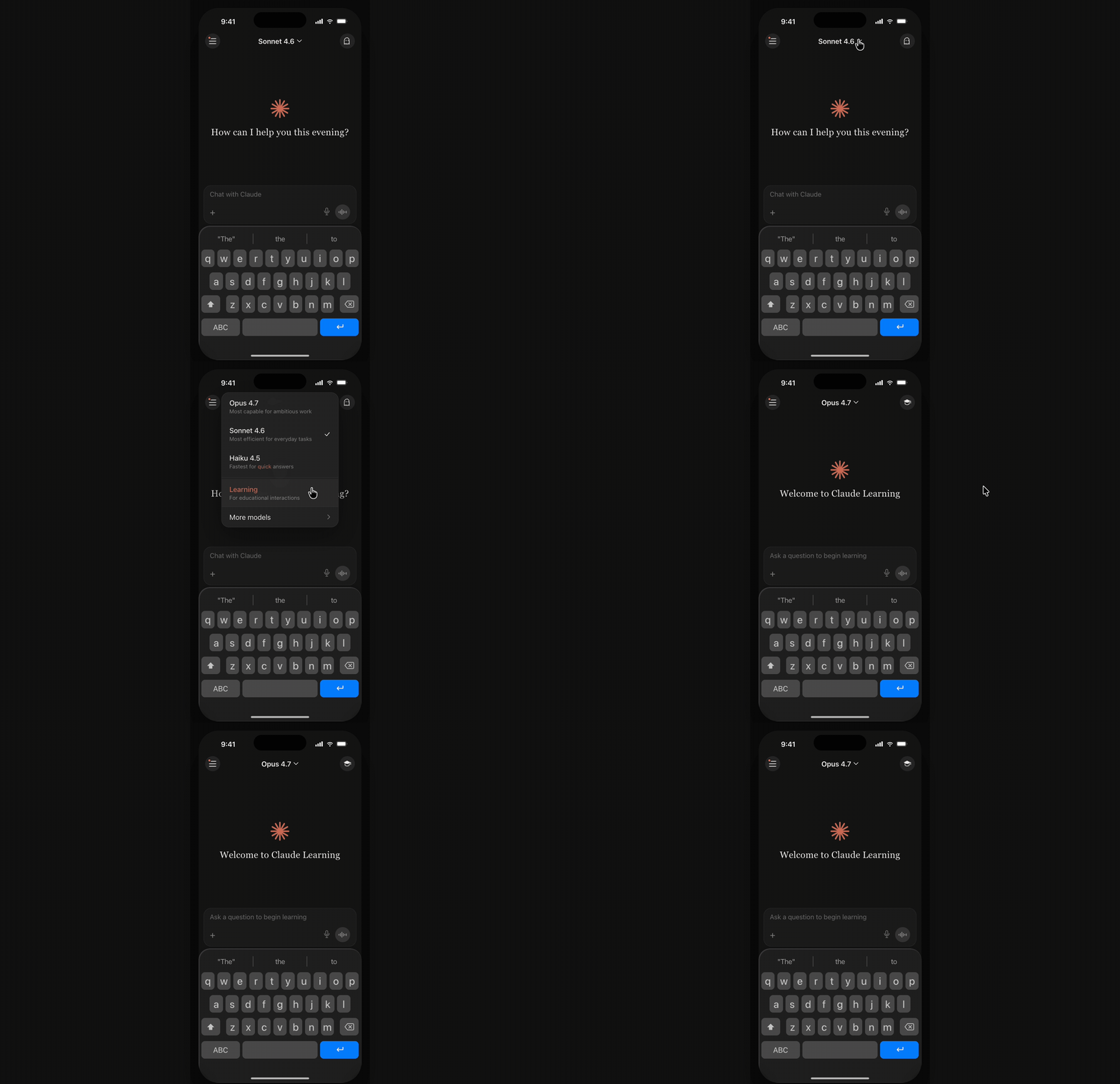
One solution is to design a dedicated learning environment, a learning model. For this concept I pulled from principles developed when building a high-stakes educational chatbot for Fatiguefit.
In particular I've prototyped this learning model to use a design principle I've come to label as 'play don't say'.
Rather than telling a learner the answer, the system invites them to play toward it. Think of it as levels in a learning game, small challenges, immediate feedback, the sensation of playing pong with an opponent as you learn to use a paddle.
When we learn through feedback loops, over time the guide or the AI system in this example can read engagement patterns and refine the difficulty and style of challenges presented to the user.
This type of personalization is a largely under-utilised educational superpower for AI platforms have at their disposal.
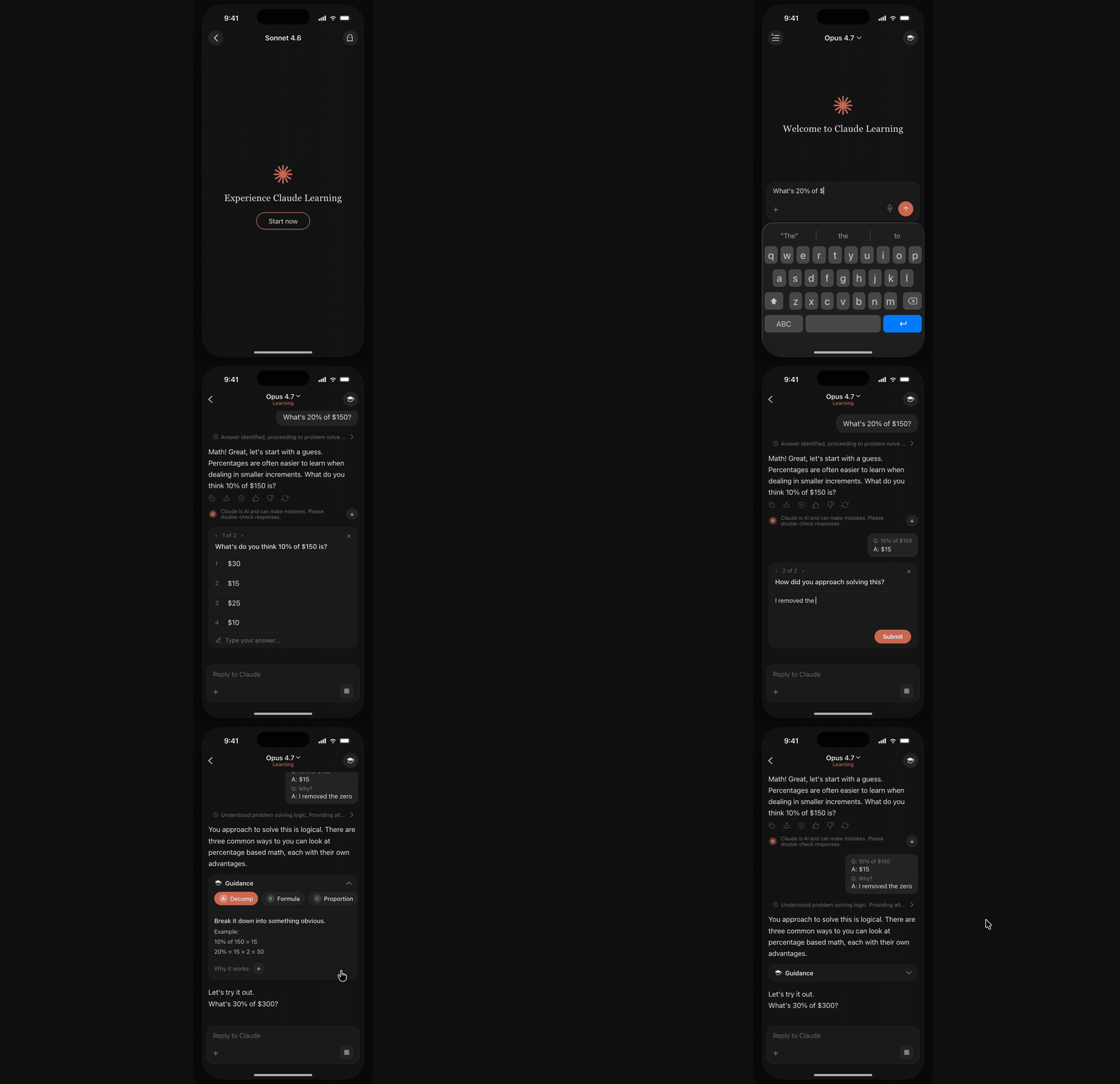
Explicit Claude Learning flow by: Lyndsey Fisk
This first prototype is far from perfect, it's not trying to reinvent learning, nor does seek to redefine the design systems of Claude. It stays native to the current experience and uses basic Q&A patterns to test a specific concept:
Can we introduce the right kind of friction to shift a user from passive recipient to active learner?
The learning mechanic itself is already proven, but after some light user testing, I quickly hit pushback:
"I mostly just want an answer I don't want a quiz!"
Predictable. Learning requires opting in to effort. Now we have a second and perhaps more important design challenge.
How might we encourage the behaviour of using explicit learning environments to with AI chatbots?

NUDGING BEHAVIOR

Given the choice between an instant answer and putting in effort to work toward one, most people will take the instant answer, worse, this behaviour is being continually reinforced.
For situations where time to answer is crucial it's justified, however for situations of learning it becomes a behavior we must overcome.
So how do you create conditions where someone chooses effort, how can you encourage an action to learn?
Behavioral design.
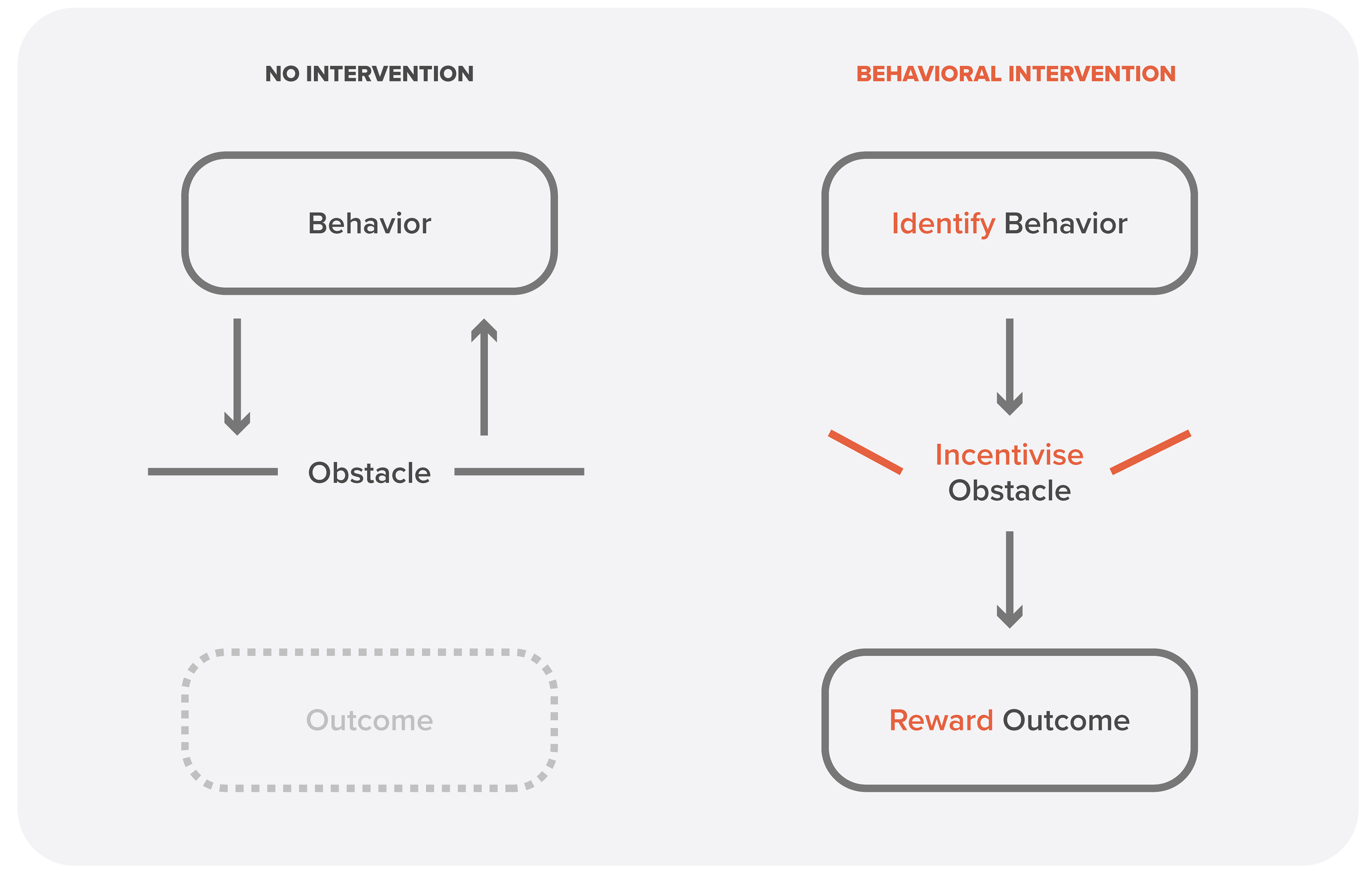
How to nudge behaviour: Lyndsey Fisk
Now that the behaviour to seek immediacy of an answer has been identified as an obstacle to learning, overcoming it requires an incentivised prompt.
For delivery of the prompt, I've chosen contextual nudging. Micro, well-timed invitations to act. You've experienced it buying groceries: "round up and donate?" That's a nudge.
However, understanding the outcome to incentivise towards, and the reward for getting there is key to make the nudge work. We need to think ahead, understand the benefits where moments of learning would outweigh the additional effort required.
So, where might those moments occur?
1. Speed: Questions that are faster to self-solve if learned.
2. Desire: Topics of knowledge the user seeks to advance in.
3. Status: Social credibility of demonstrating a new skill
Ok, Let's design a nudge!
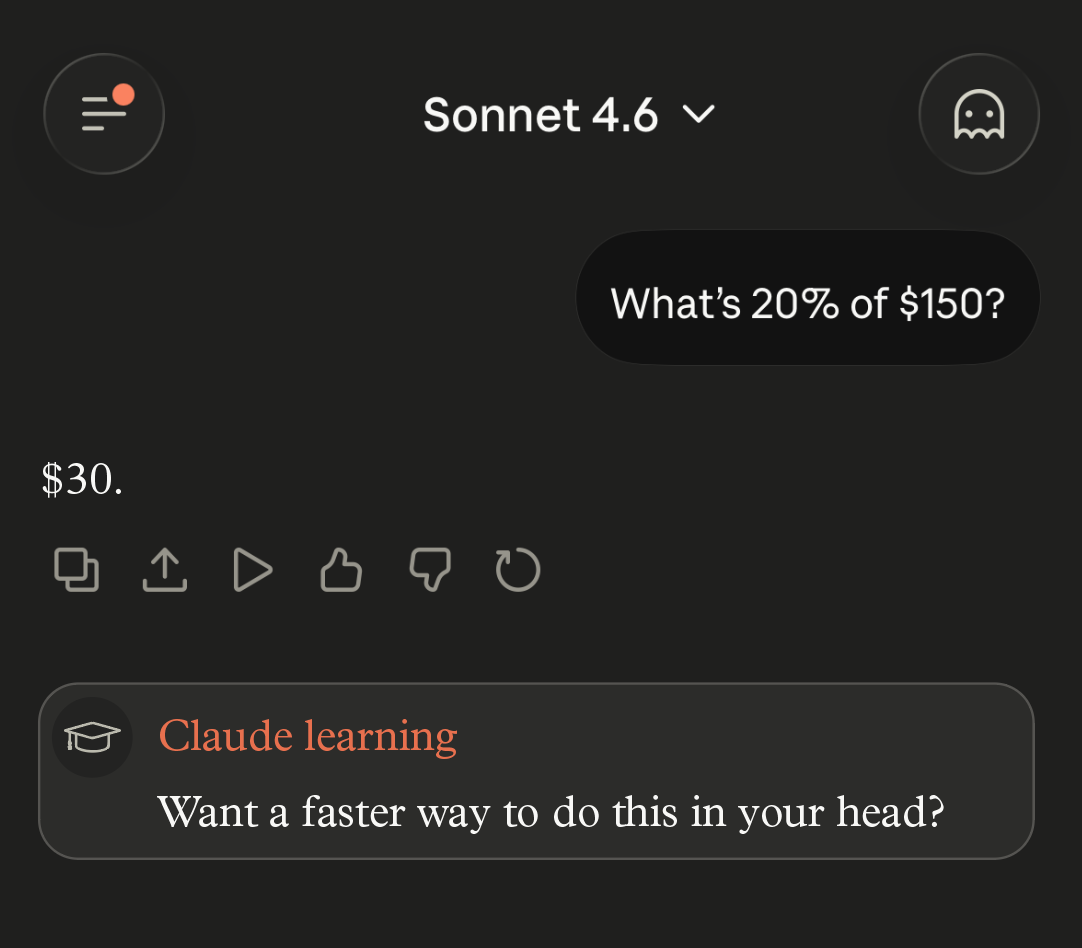
Contextual nudge design. Lyndsey Fisk
Beyond selecting the best moment to deliver a contextual nudge, the additional lever I pulled is one obtained the hard way, across years of teaching and building international programs at RMIT: Lead with curiosity.
Curiosity is effort melting magic, it may just be the greatest incentive to overcome an innate desire to conserve energy. It's the reason you get off the couch when there's a strange sound outside, and we can harness it in design.
The nudge I've experimented with in this context, attempts to contextually incentivise that curiosity: "Want a faster way to do this in your head?" is subtly packed with incentived rewards:
Speed: Use this tool to increase time to outcome
Desire: Get skilled on a topic of repeat inquiry
Status: Offers ownership of a new capability
The nudge seeks to imply there's a way to do something the user doesn't know about, but crucially does not provide the answer to that here. This is a the magic hook of curiosity, leaving the door slightly ajar to encourage looking behind it.
The goal isn't to make Claude harder to use. It's to make the moments where learning is appropriate feel like play, not homework.

LIMITATIONS

I want to be honest about the limitations of what I've built here, because I think the honest limitations are as instructive as the potential solutions.
Interface assumption
These prototypes live inside a chat window. That's a constraint, not a solution. We're still stuck in a box, which means we're not yet designing for multimodal learning that happens in the physical world, in conversation, in doing.
Prototype crudeness
The interactions would need contextual testing, significant model refinement, and deeply personalized calibration of messaging with measured learning outcomes.
What I've built is a proof of concept, not a proof of product.
Privacy and control
How you learn can be modeled. And what can be modeled can be used to steer you toward learning, but potentially toward other things too. Any system that observe learning behavior also have an obligation to signal that explicitly to the user.
The learner should always know when they're being taught.

RESULT

An observation, a prototyped learning environment, some light user testing, and a refined behavioural nudge to get us using it. Small steps that may contribute towards a solution that promotes growth of AI-assited learning.
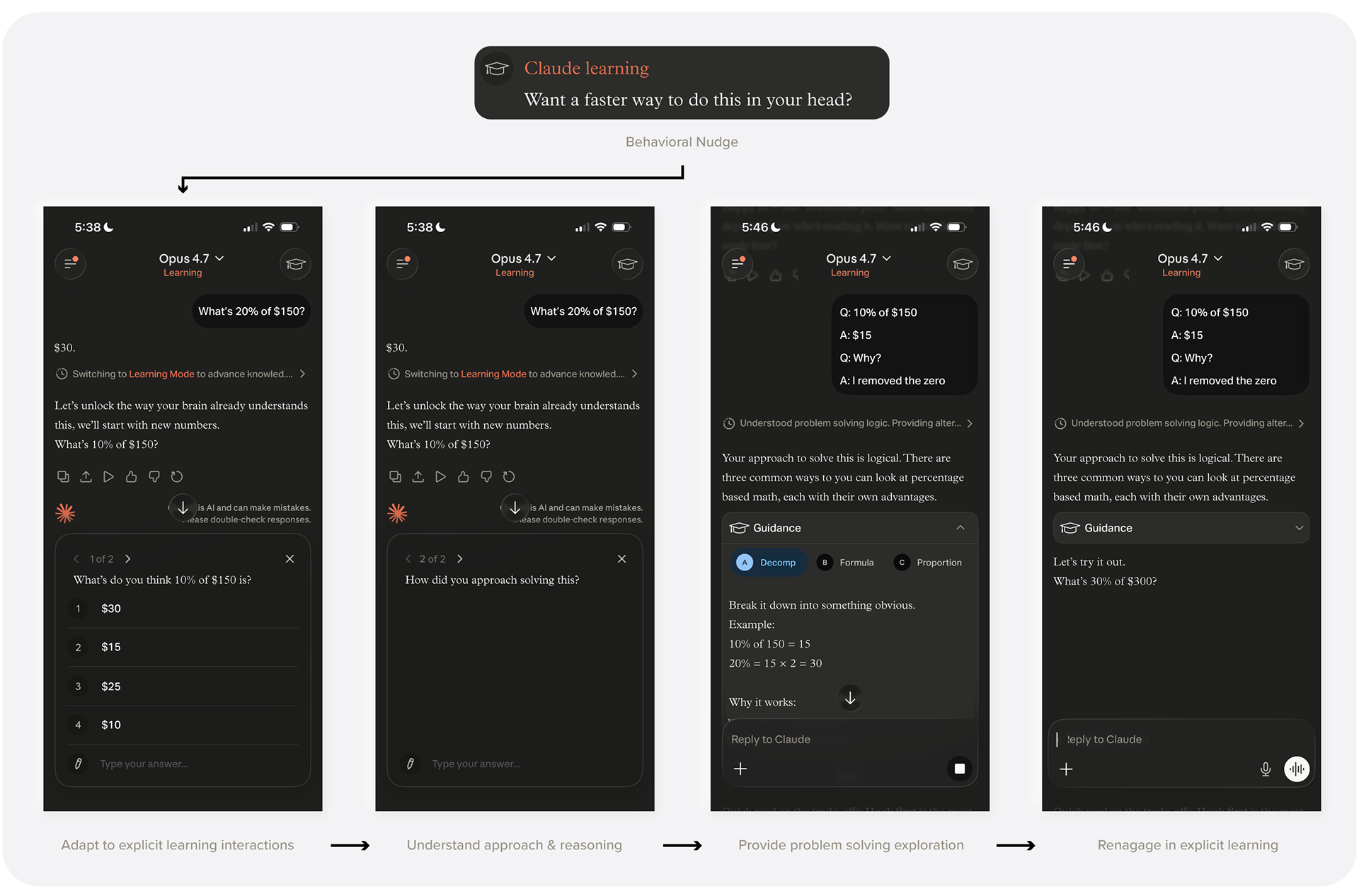
Nudge to Learning environment flow . Lyndsey Fisk
Learning products can be amongst the highest retention products in market because they establish relationship and trust, reinforced when positive transformation occurs. These experiences become meaningful life moments for people, and commercially it's a win-win that results in high customer lifetime-value.
One challenge here is that there's a short-term commercial conflict to overcome. Explicit learning interactions require more compute, more energy, more cost, I see this as a solvable problem, but it raises a bigger question...
Are we building AI that does its greatest work in the long term, or are we fixated on solving for the short term?



As multimodal technology matures, intent inferred through gaze, tone, pause, and gestural learning moves out of the chat window and into the world. The design decisions we make now about agency and the handoff between human and system will determine whether that future makes people more capable, or more dependent.
I'm optimistic we get it right. The opportunity to help millions of people to become more curious, more capable, and more engaged with the world around them is one of the most meaningful things we could build.
I'd place my bet on designing for human intelligence, not just human utility. That's a world worth creating.